Leg design
How the legs with two times six degrees of freedom are built, and the choice of servos and print material.
On this page
Overview
Each leg has six degrees of freedom (DOF), twelve servos in total. The legs are about 43 cm long; the whole robot is 90 cm tall.
| Property | Value |
|---|---|
| Degrees of freedom | 2 × 6 DOF |
| Servos | 12 units |
| Servo size | 40 × 40 × 20 mm |
| Leg length | approx. 43 cm |
| Material | PETG-CF |
| Printer | Bambu Lab P1S (AMS) |
From the first draft to the new leg
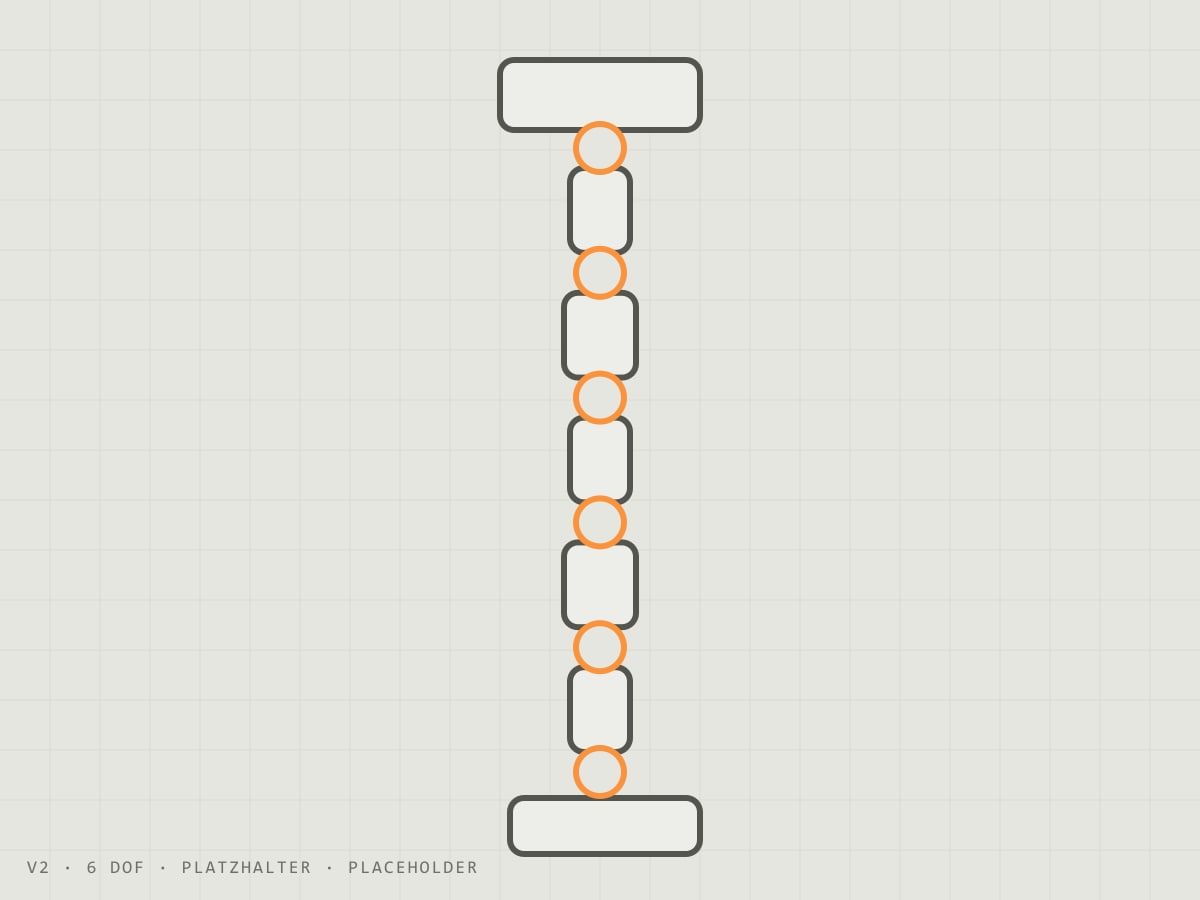
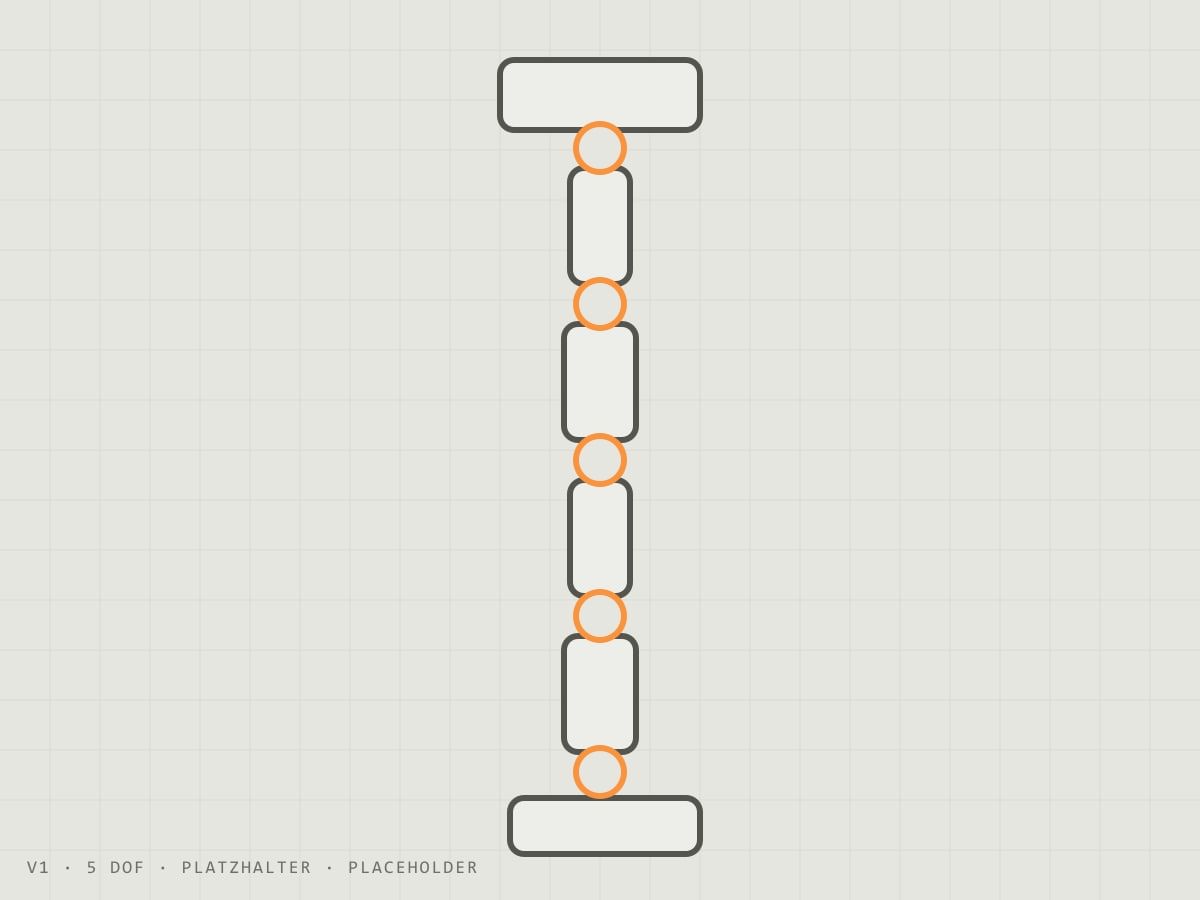
[PLACEHOLDER: what was the problem with the old leg, and what does the new one do better?]
Kinematics
The six joints per leg are distributed like this:
| Joint | Axes | Movement |
|---|---|---|
| Hip | 3 | Rotate, spread, bend |
| Knee | 1 | Bend |
| Foot | 2 | Bend, tilt |
Driving the servos
The servos are connected to PCA9685 PWM boards, which the Raspberry Pi addresses via I²C. A short example in Python:
from adafruit_servokit import ServoKit

# One PCA9685 board has 16 channels
kit = ServoKit(channels=16)

# Move the servo on channel 0 to its center position
kit.servo[0].angle = 90
Material choice: PETG-CF or ASA CF
For the load bearing parts we compared two carbon fiber reinforced filaments.
| Criterion | PETG-CF | ASA CF |
|---|---|---|
| Stiffness | [PLACEHOLDER] | [PLACEHOLDER] |
| Printability | [PLACEHOLDER] | [PLACEHOLDER] |
| Temperature resistance | [PLACEHOLDER] | [PLACEHOLDER] |
| Cost | [PLACEHOLDER] | [PLACEHOLDER] |
We chose PETG-CF. [PLACEHOLDER: reasons.]
Print settings
[PLACEHOLDER: nozzle, layer height, wall thickness, infill, temperatures.]